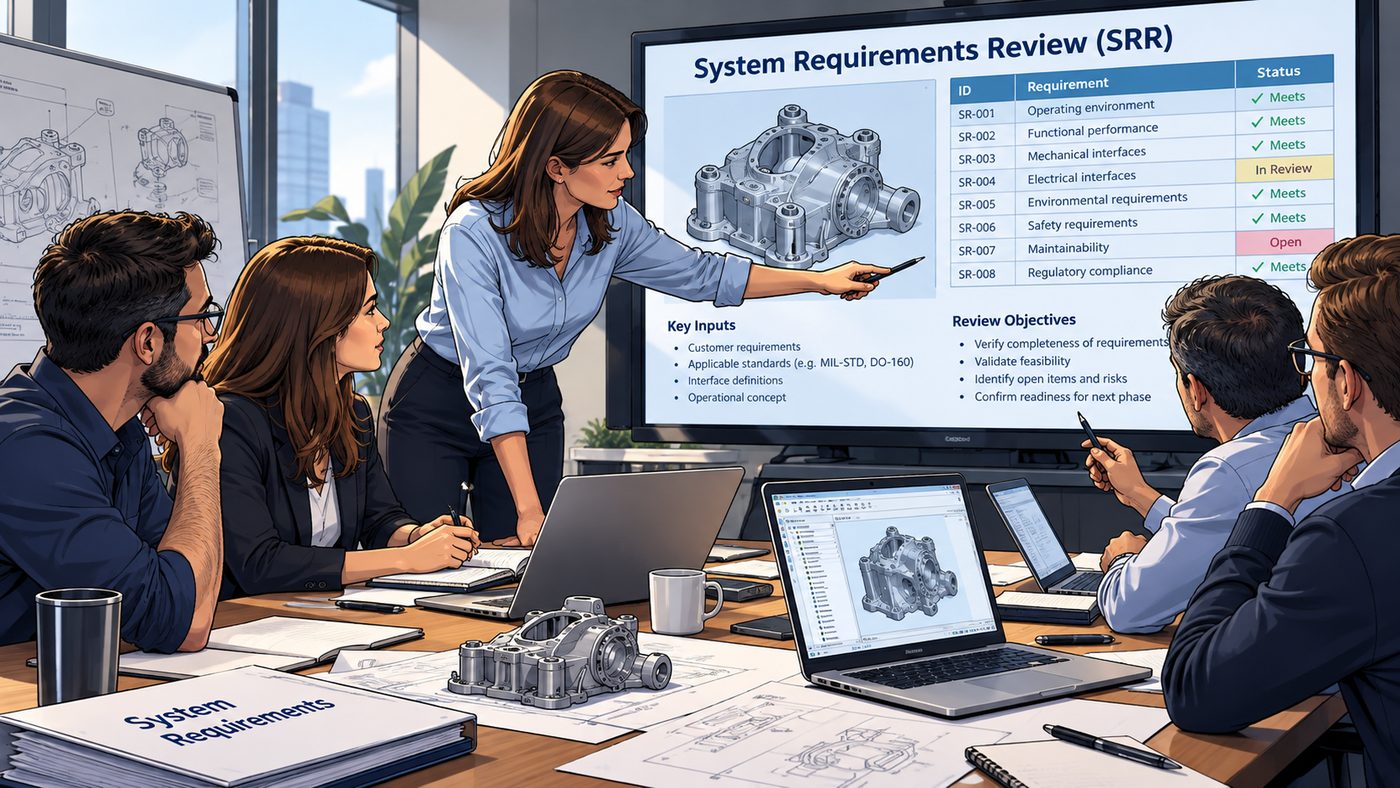
Once the SOW has defined the project's boundaries, objectives and content, the next stage is the System Requirements Review (SRR). It is an early checkpoint that confirms all requirements are feasible, complete and verifiable, and that they form a stable basis for the rest of the work.
The SOW describes what the project requires. The SRR checks whether the requirements derived from it were correctly translated into a System Requirements Document, and whether development can proceed on that basis.
What an SRR Is
An SRR is a formal review, usually with many participants: the client, the development team, and often representatives from management, quality and other supporting functions. The review examines:
- Completeness: Have all requirements been mapped from the SOW, the regulatory specifications and the business needs?
- Clarity: Is the wording clear and free of double meanings?
- Verifiability: Can a test or validation scenario be defined for each requirement?
- Traceability: Is there an unambiguous mapping between each requirement and its source, and between each requirement and its sub-requirements?
- Technical feasibility and schedule: Are the requirements realistic given the existing capabilities and resources?
The SRR makes sure development does not start before all parties have agreed on the rules of the system.
Why It Pays Off
According to industry studies, an early mistake, such as a wrong or missing requirement, can cost ten times as much or more when it is discovered in advanced stages of development and manufacturing. A thorough SRR provides:
- Lower risk: Unclear or infeasible requirements are found early.
- Saved resources: No unnecessary development and no redesign.
- Better communication: Every party confirms they understand the requirements the same way.
- Trust: The client sees that the team checks every detail and heads off surprises.
How an SRR Runs
It is usually a series of presentations and discussions. The development team presents the System Requirements Document, shows how each requirement derives from the SOW or another source, and shows the link between top-level requirements and subsystem requirements.
Participants ask questions, point out gaps and check that each requirement meets the quality criteria. At the end of the review, decisions and follow-up actions are recorded: requirements to correct, requirements to examine further, or full approval to proceed.
The Basis for the Next Stage
Once the SRR is approved, the requirements document becomes the Baseline: an official reference that is not changed lightly. Any later change to the requirements goes through a formal Change Control process. This keeps the project under control and prevents scope creep, which can disrupt the schedule and the budget.
The SRR is also the entry point to the next stage, usually the Preliminary Design Review (PDR), where the system's initial architecture is checked against the requirements.
Summary
If you have written an SOW and have not yet started development, do not skip the SRR or treat it as a formality. A thorough SRR meeting with all stakeholders lets you start with agreed requirements and reduces the risk of delays and unnecessary costs later.