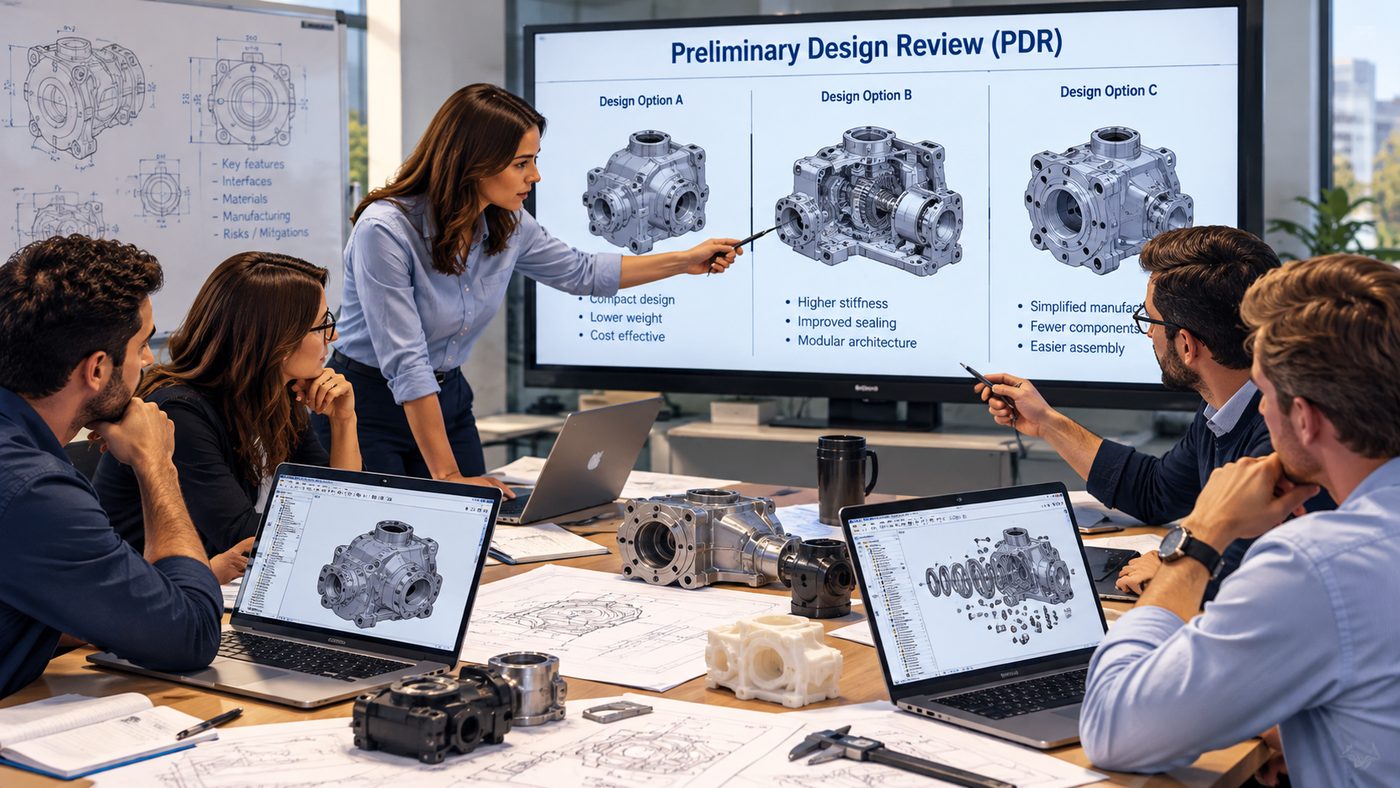
Once the SRR is complete and the requirements are approved, the project moves to the Preliminary Design Review (PDR). At this stage the requirements document becomes initial 3D models that show the system and its components in physical space.
In the PDR you can already see the product, but the design is still high-level and flexible. Several alternatives can be presented for each main component, the design can be checked against the functional requirements, and initial risks can be identified before moving into final details at the Critical Design Review (CDR).
What the PDR Examines
In the PDR we focus mainly on the product's initial mechanical design, while keeping it tied to the overall systems engineering:
- Initial 3D models: Show the product at full size, let us check interactions between components and simulate movements and functions.
- Design alternatives: For each component or subsystem we present several options, with the pros and cons of each, to choose the best solution in terms of performance, cost, weight and ease of manufacturing.
- Fit to functional requirements: We check that the design meets the loads, operating angles, motor force, friction and motion of moving parts.
- Initial material selection: Materials suited to the forces, temperatures, operating environment and manufacturing processes.
- Initial manufacturing and assembly planning: We confirm the system can be made with existing processes: CNC, molds, 3D printing, manual assembly.
- Early risk identification: Stress points, friction, mismatch with existing motors or components, and assembly complexity.
How a PDR Runs
A PDR usually includes these steps:
- Presenting the models: Each component, subsystem and the full system are shown in a 3D model, including a demonstration of movements and interactions. This way all participants see the product as it will look in reality.
- Reviewing design alternatives: For each main component several options are presented, for example connection type, motion mechanism or material. Each alternative is listed with its pros and cons: cost, weight, manufacturing complexity, durability and operation.
- Initial check against requirements: The engineers show how each component meets the requirements defined in the SRR: loads, motion, force, friction, installation space and coordination with other components.
- Materials and components table: For each component the proposed materials are listed with their availability, cost, weight and durability.
- Initial risk identification: Problem areas, complex requirements or possible mismatches are identified early to prevent delays later on.
- Summary of decisions and follow-up actions: Every decision, change or correction is recorded, and follow-up actions are set. At the end of the PDR there is a clear framework for further development and for preparing the CDR.
What a Thorough PDR Gives You
- Early detection of mechanical problems: Prevents mismatches, unnecessary loads and friction.
- Certainty for the client and the team: Everyone agrees on the system structure, the relationships between components and the force design.
- Fewer deviations from requirements: Fewer major changes at later stages.
- Organized documentation: Every decision on a material, component or connection is recorded and can be traced throughout development.
- Comparison of alternatives: An informed choice between several options for each component.
- Early manufacturing planning: The design matches manufacturing capabilities.
Summary
In the PDR the product takes physical shape for the first time, so this is the time to understand the whole system. Ask questions until every component, connection and movement is clear to you, and make sure you understand the differences between the design alternatives presented. The decisions made here determine the product's stability later on.