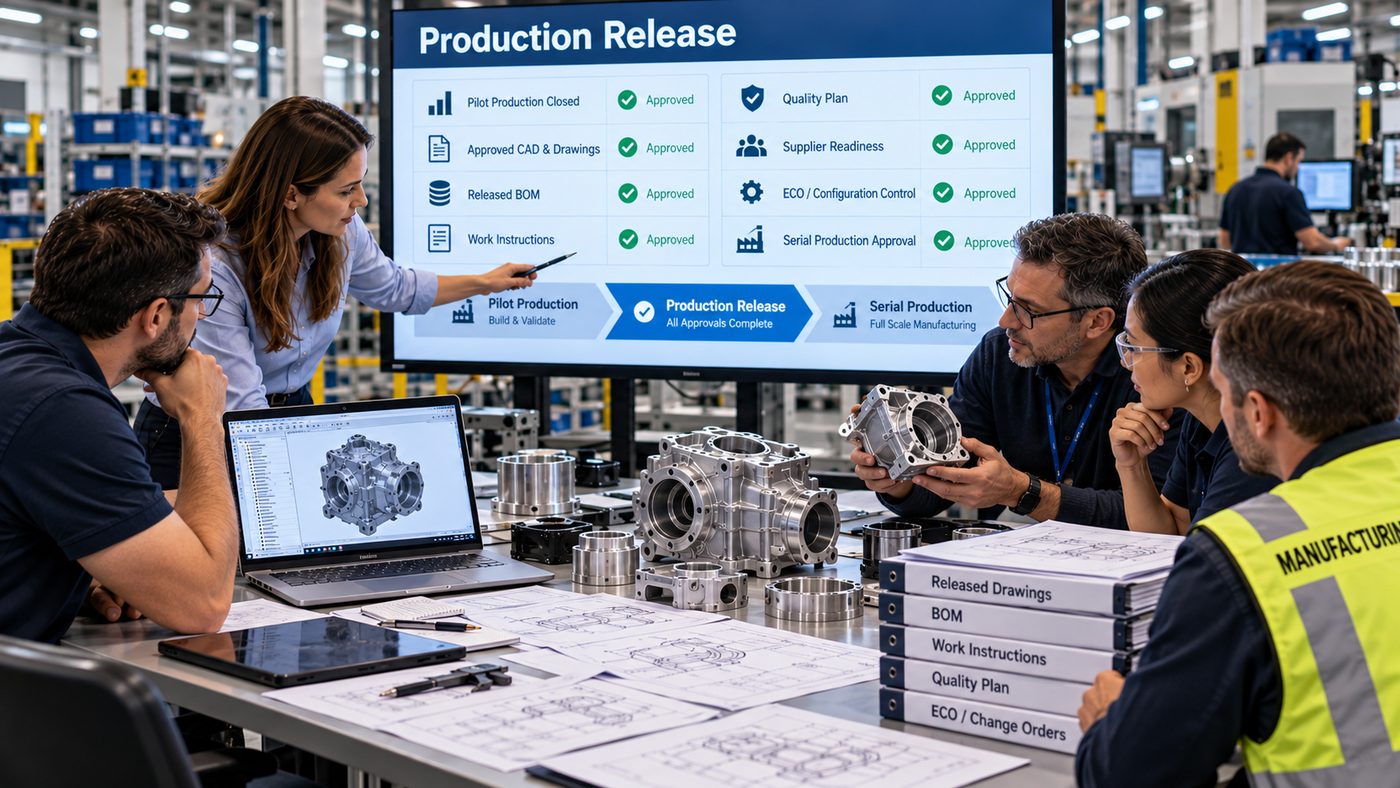
In Pilot Production we made a first batch, examined the manufacturing processes and found gaps between the design and actual execution. The last stage of product development is Production Release, the release to series production.
At this stage the product formally moves from development to ongoing production.
A working prototype and a successful first batch are not enough to release a product to production. All processes, documents, components and tests must be updated and approved, and it must be possible to make the product consistently, at the required quality and the planned rate.
What happens at release
The goal is to approve the product configuration and the manufacturing process, and to make sure everyone involved works to the same approved revision. The work focuses on the following areas.
Closing pilot findings
All gaps and problems found during Pilot Production are reviewed and resolved. These include assembly difficulties, dimensional deviations, recurring faults, abnormal production times and functional problems found during the run.
Before release, all significant findings must be closed, and the fixes that were implemented must be tested and verified.
Design approval and configuration control
A product usually goes through many changes during development. At release there must be a clear, approved configuration for production.
That means all CAD models, manufacturing drawings, bills of materials (BOM) and assembly instructions match each other and represent the approved revision.
Any future design change goes through a formal change control process, such as an ECO (Engineering Change Order).
This prevents a situation where production works to one revision, purchasing orders parts to another, and quality inspects against an outdated drawing.
Releasing manufacturing and assembly instructions
The manufacturing process must be clear, documented and repeatable. At release, the team confirms that all work instructions are up to date, production and assembly tooling is available, and the required inspection points along the process are defined.
The goal is to reduce dependence on any one worker's personal knowledge as far as possible, and to work consistently to an approved process.
Approving quality and test processes
Before moving to series production, clear acceptance criteria for the product must be defined: dimensional checks, functional tests, accept or reject criteria, and documentation of test results.
Where needed, special manufacturing processes are qualified and the test and measurement equipment is verified as suitable.
Handover to production
At this stage responsibility moves from the development team to the production team. The engineers remain available, but responsibility for ongoing production passes to the right people in the organization.
So the team confirms that all the required knowledge has been handed over: engineering documentation, work instructions, sensitive points, test procedures and instructions for handling nonconformances.
Why a formal release matters
A formal release to series production provides:
- Product consistency: every unit is made to the same approved configuration.
- Fewer production errors: work follows current instructions and documents.
- Change control: uncontrolled changes do not enter the manufacturing process.
- Quality and repeatability: a process that meets the requirements consistently.
- Clear responsibility: a defined interface between development, production, purchasing and quality.
How release works in practice
There is usually a release review, where representatives of engineering, production, quality and purchasing assess whether the product is ready. The review covers:
- A summary of the Pilot Production results.
- The approved engineering documentation set.
- The list of changes that were closed and verified.
- Updated manufacturing and assembly instructions.
- Test and quality control plans.
- Confirmed availability of components, raw materials and required equipment.
After reviewing the findings, the decision is one of three: release to series production, release subject to defined conditions, or complete further actions before approval.
The release itself is clearly documented, so everyone knows which configuration is approved and the conditions for producing it.
Summary
This is the last stage of the development process. Each stage in the series built on the outputs and decisions of the one before it:
- In the SOW we defined the scope of work and the project goals.
- At SRR we reviewed the system requirements and their feasibility.
- At PDR we developed a preliminary design and evaluated engineering alternatives.
- At CDR we completed the detailed design and set an approved engineering baseline.
- At PBR we built the prototype and tested the design in the physical world.
- At PRR we reviewed the readiness of manufacturing, purchasing and quality processes.
- In Pilot Production we confirmed the product can actually be made, repeatably and consistently.
- At Production Release the move to series production is completed.
This is the principle of orderly engineering development: do not move to the next stage until its foundation is clear and established. A good product is one that can be made, assembled, tested and maintained consistently and reliably.
Engineering work continues after release. Process improvement, problem solving and change control stay with the product throughout its life. But at this point the initial development process is complete, and the engineering idea has become a manufacturable product ready for use in the field.