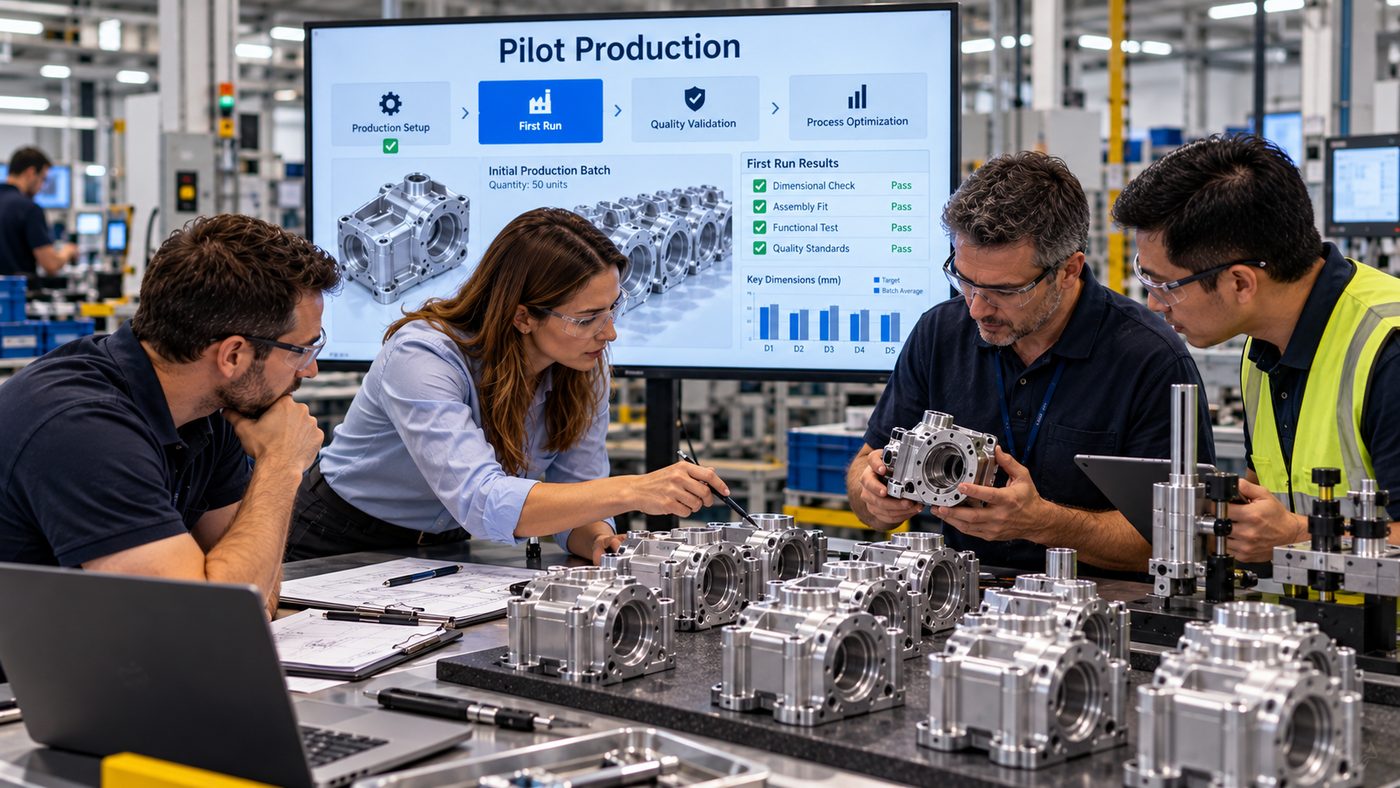
At PRR (Production Readiness Review) we confirmed that manufacturing, purchasing, quality and documentation were ready. The next stage tests that preparation in practice: Pilot Production, the first production run.
Until now we built a prototype to prove the product works. Now the goal is to prove it can be made again and again, with consistent quality, an orderly process and reasonable cycle times.
A product that works well as a prototype is not necessarily easy to make in volume, which is why this stage carries so much weight in development.
What happens in Pilot Production
A first, limited batch is made, using as far as possible the equipment, materials, work instructions and processes intended for series production.
The goal is to examine the whole manufacturing process, beyond getting good units at the end, and to find the gaps that appear when moving from one-off builds to repeated production.
Manufacturing and assembly
The team checks that the product can be made and assembled according to the defined work instructions. They check whether the sequence of operations makes sense, whether every component is easy to reach, whether special tools are needed, and whether any operations complicate or lengthen assembly.
This is often where small design changes are found that make manufacturing much simpler.
Work times and throughput
Pilot Production gives the first real data on manufacturing, assembly and test times. The team checks whether cycle times match the estimates, where bottlenecks form, and whether the required production rate can be met.
This data makes it possible to adjust before quantities increase.
Quality and repeatability
One of the main differences between a prototype and series production is repeatability. One unit that works is not enough. The following units must meet the same requirements.
So dimensional checks, functional tests and quality control are carried out throughout the process, to catch deviations, recurring faults and sensitivity to production variation.
Suppliers and components
The pilot run also tests the supply chain in practice: whether components arrive on time, whether different production lots are consistent, and whether parts from different suppliers fit the system well.
This exposes availability, fit and quality problems before they affect large production quantities.
Findings and process improvement
Every deviation, assembly difficulty or fault found during production is documented and reviewed. As needed, drawings, work instructions, production tooling, test procedures or components are updated.
Every change must go through a proper approval and configuration control process, so no gap opens between the approved design and the product actually being made.
Why Pilot Production matters
Pilot Production tests the product and the manufacturing process under conditions as close as possible to series production, at a limited scale. It makes it possible to achieve:
- Early problem detection: finding manufacturing and assembly difficulties before quantities increase.
- Better efficiency: finding unnecessary operations, bottlenecks and abnormal work times.
- Verified repeatability: confirming that multiple units can be made to the same requirements.
- Better quality processes: fitting inspection points and tests to the actual manufacturing process.
- Lower risk: fixing problems while changes still have relatively limited cost and impact.
How Pilot Production works in practice
A limited quantity is usually defined in advance, along with clear success criteria. During the run, data is collected and the work process is tracked.
At the end of the stage there is a review that examines:
- Quality and functional test results.
- Actual manufacturing and assembly times.
- Faults, rejects and rework.
- Fit of the equipment, tooling and work instructions.
- Open findings and changes required before scaling up production.
Based on the results, the decision is whether the manufacturing process is ready for the next stage, needs targeted adjustments, or needs another pilot run.
Summary
At PBR we checked that the prototype works, and at PRR we confirmed the system is ready for production. Pilot Production tests whether the product can be made consistently, efficiently and repeatably. This is the stage where the manufacturing process itself is tested.
The next and last stage in this series is Production Release, the release to series production. It closes the gaps found in the pilot run, approves the documentation and processes, and moves the product from development to ongoing production.
That completes the process that started with an idea and a SOW, ending with a product that can be made in an orderly, consistent way at the required quality.