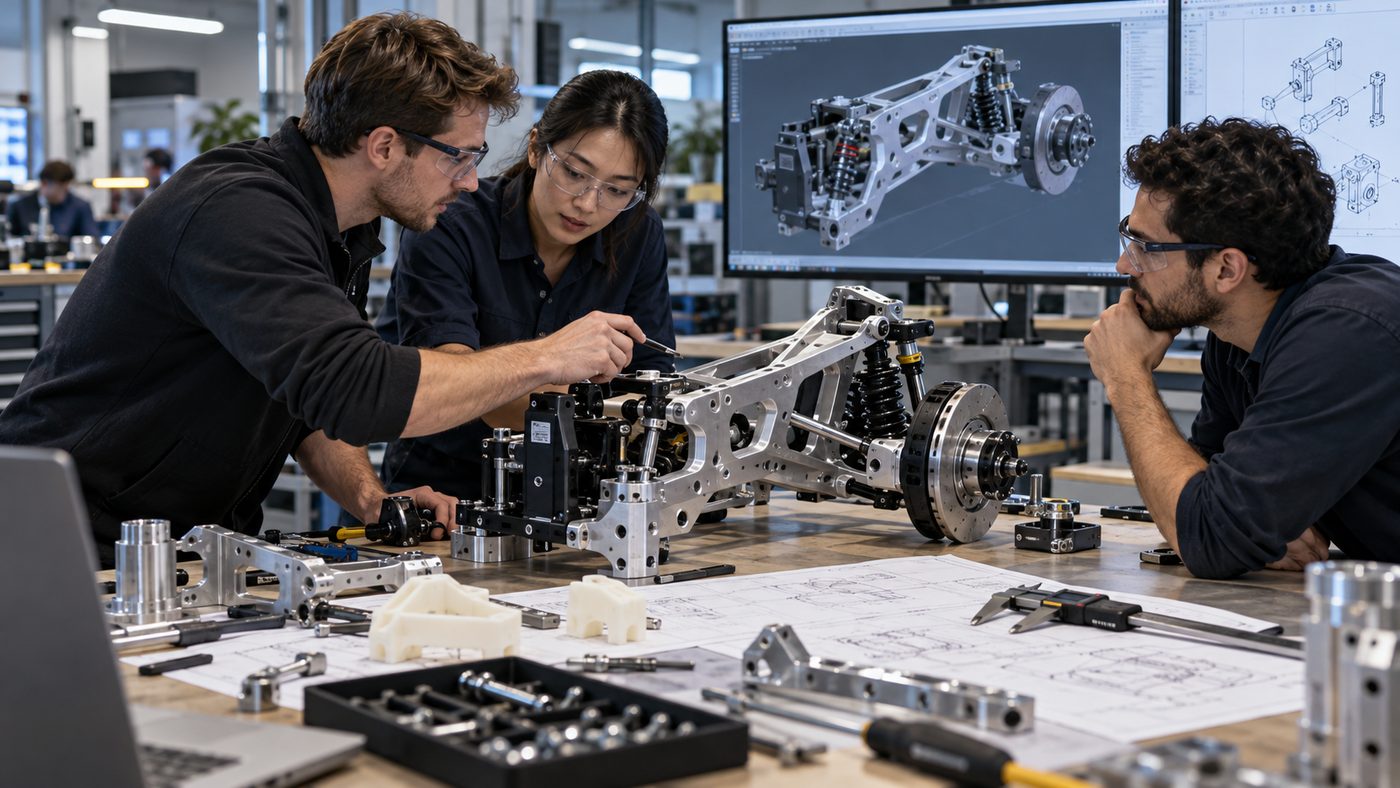
Once the design has passed CDR and been set as the baseline, it leaves the screen and gets built. This is the Prototype Build Review (PBR): the design is tested on real parts.
At CDR the focus was engineering accuracy and tolerances down to the micron. At PBR the focus is how parts actually fit together, how the mechanism behaves, whether components are available, and how manufacturing and assembly work in practice. This is the first time you see the system move, hear its vibrations and find out what works as designed.
What happens at PBR
The goal is to confirm that the system can be built in reality, outside the computer model. The stage combines initial manufacturing, assembly checks and functional verification of the physical product.
Initial parts
Parts are made from the approved drawings. To save time, temporary methods are sometimes used, such as 3D printing, laser cutting or fast CNC machining. This is not series production yet. The goal is verifying engineering feasibility: confirming that what was designed can be manufactured and assembled.
Assembly
PBR is where DFA (Design for Assembly) is tested in practice. It shows whether the design allows simple, clear assembly, or whether it needs geometric changes, better access or a different assembly sequence.
Initial functional tests
After assembly, the system goes through motion, control and response tests. Final reliability is not verified at this point. The tests confirm that the mechanisms work as intended, with no collisions, abnormal vibration or dimensional deviations.
Findings and fixes
Every problem found is documented: what the fault is, what it affects and the proposed fix. These findings are the basis for most of the conclusions carried into series production.
Why PBR matters
A prototype tests how mature the design is. Doing this stage properly prevents expensive mistakes later and makes it possible to:
- Verify the engineering feasibility defined at CDR.
- Check how easy the product really is to assemble and maintain.
- Find problems that were not visible in the digital model.
- Improve reliability and coordination between design and manufacturing teams.
- Build confidence in the design before moving to series production.
How PBR works in practice
There is usually a formal review meeting. The prototype is presented to the engineering, manufacturing and quality teams, and sometimes to the customer. The meeting covers:
- Manufacturing and assembly reports, including work times and faults.
- Videos and photos of the process.
- Results of motion and control tests.
- A list of proposed changes (ECR/ECO).
At the end of the review, the decision is whether to move to initial production (Pilot Production) or build another prototype round.
Summary
At CDR we designed, and at PBR we built and tested. The next stage is the Production Readiness Review (PRR), which checks that the manufacturing, purchasing and quality chain is ready to produce the product.