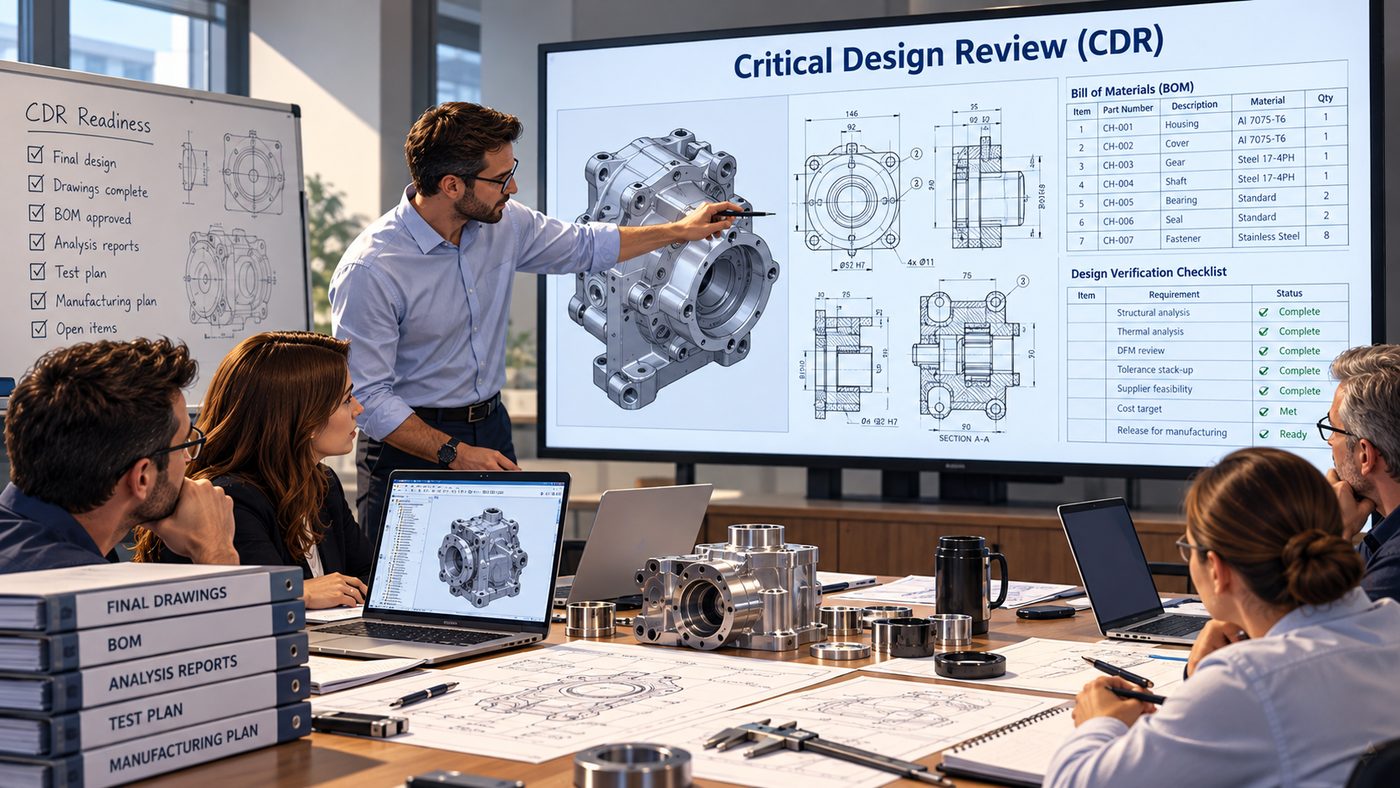
Once the PDR is complete and the design direction is approved, the system moves into a stage of numbers, dimensions and precise engineering details. At the CDR the product is almost ready for manufacturing, and every decision affects how it will perform in practice.
At the CDR the design becomes a complete engineering plan that can be executed. The engineers move from the overall picture to detailed verification of every component, movement and connection. At this stage there is no more room for major changes: any change will affect the design, the costs and the schedule.
What the CDR Examines
The purpose of the CDR is to confirm that the design is ready for development and manufacturing. It is a thorough review of every aspect of the system: mechanical, electrical, thermal, software, safety and maintenance.
We check that the product works, and also that it can actually be manufactured, assembled and maintained. In mechanical engineering, the CDR covers:
- Detailed 3D models: The models from the PDR go through full refinement: dimensions, tolerances, clearances and assemblies are examined in depth. Every bolt, bearing and mechanism is checked in motion to make sure there is no interference or unplanned load.
- Strength tests and simulations: Strength (FEA), flow, vibration and thermal analyses are performed to confirm that every component withstands the expected loads and that the system as a whole performs in a stable and safe way. If a structural change is needed, this is the last opportunity to make it without unnecessary manufacturing costs.
- Complete engineering drawings: A full set of production and assembly drawings is created for each component, with exact dimensions, manufacturing notes, process instructions and tolerance callouts. These drawings later serve as the shared language between the design, production and quality teams.
- Full bill of materials (BOM): The BOM is updated down to real components, including part numbers, suppliers, availability and costs. Alternative components are sometimes evaluated in case of low availability or a change of supplier.
- Design for manufacturing (DFM) and assembly (DFA): We check that every component can be made with existing processes: machining, casting, 3D printing. The goal is that the design will not cause delays or excess costs on the shop floor. The assembly check examines whether the product can be assembled simply and clearly, without special tools or difficult operations in the field.
- Interfaces with other systems: The engineers check that the product fits the existing systems: electrical, control or compressed air. Small gaps are sometimes found here that could become a major obstacle at later stages.
- Final engineering risk review: Every risk identified in the PDR is checked again: whether it was resolved, and whether the design updates created new implications.
How a CDR Runs
A formal CDR meeting is usually held, where the whole system is presented to the development team, management and sometimes client representatives. The purpose of the review is for all participants to see the same picture before moving to production.
The meeting presents simulations, analyses, 3D models and test summaries. Every change, deviation or issue is recorded in the minutes. At the end of the review a decision is made whether to approve the final design or send it back for another update.
When the CDR Is Approved
A CDR is considered approved when the system meets all technical, functional and logistical requirements, and there are no open issues that could prevent the move to production or to prototype build.
At this point the design receives the status of Baseline Configuration, the official design version. From here on, every change goes through formal configuration control.
Why Invest in the CDR
There is a tendency to rush into production to see something working. Investing in the CDR saves time and money in the long run:
- A problem found before production saves expensive fixes.
- Production and purchasing can be planned better.
- Fewer surprises in performance and field testing.
- The client understands exactly what they are getting and can rely on the design.
- Product maintainability and reliability improve over time.
Who Should Take Part
It is worth bringing representatives from production, maintenance and service into the CDR, in addition to the engineers. People who know the field spot problems that are not yet visible on screen. Their input at this stage can make the difference between a product that works over time and one that needs repeated changes after launch.
Summary
In the PDR the product started to take shape. By the end of the CDR every component has been designed, checked and approved, and the system is ready to move into the physical world.
The next stage is the Prototype Build: the move from the screen to the first prototype, in metal and plastic and with real motion. This is where the assumptions are validated, functionality is tested and preparation for series production begins.